

Yielding to the Pressure
A Look at the Historical Use of the Yielding Glide and its Practical Application in Modern Historical and Classical Fencing
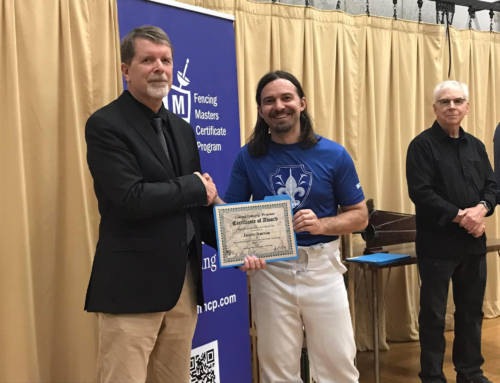
This past summer I took the online Fencing Pedagogy & History class, as part of the Sonoma State University Fencing Master Certificate Program (SSU FMCP). The class itself deals with traditional Italian fencing pedagogy and Franco-Italian fencing history. I took it as part of the requirement to test for Provost of Arms (which I’m aiming for, if all goes well, summer 2026).
Part of the online class requirements is to write a paper on a fencing topic. I bounced around a few ideas, but settled on yielding glides as they’re an action I enjoy but don’t really exist in modern or classical fencing. So I wanted to explore it’s use in fencing from the 17th Centuries onward. I also wanted to see how the action could fit in modern historical fencing and classical fencing lessons.
This paper, entitled Yielding to the Pressure: A Look at the Historical Use of the Yielding Glide and its Practical Application in Modern Historical and Classical Fencing, is the end result. Figure I would share it with folks who are interested in historical fencing and sword research.
(If you’re interested, you can read more about my SSU FMCP Instructor-level test experience here).

Download! Get Yer Download Here!
You can download a PDF version of Yielding to the Pressure right here. Enjoy!
Feel free to email me with any thoughts or comments.
Abstract
The yielding glide is a relatively unknown and underutilized fencing action, sometimes stumbled upon by amateurs but relatively left out of most modern historical and classical fencing teachings. This paper will go over the use of the yielding glide in historical fencing manuals from the 17th century rapier through the dueling sword and foil of the 19th century classical fencing manuals. It will also look at how this action can be applied to historical fencing in Western Martial Arts (WMA), Historical European Martial Arts (HEMA), Society for Creative Anachronism (SCA) and modern classical fencing circles, as a tactical alternative to the disengagement and its place in lesson plans.


What is a ‘Yielding Glide’?
Before we can begin talking about the use of the yielding glide in historical manuals and how we can apply it to historical and classical fencing in the 21st century, we need to know what the action is first.
Maestro David and Dori Coblentz, in their book Fundamentals of Italian Rapier, define the yielding glide as an action that is “used against a strong engagement from your opponent. Instead of responding to the pressure on your weapon with a disengagement, you can yield to the engagement and angle around the weapon to hit while maintaining contact.”
In short, instead of opposing the force an opponent is putting against your blade or disengaging around it, you yield to it. This works off a similar principle as yielding or ceding parries found in classical fencing books, a defensive feature in modern Italian fencing traditions which yields to the pressure of a glide instead of trying to oppose it with counterforce.
Yielding glides are performed by turning the hand so the false edge of the blade faces the opponent’s weapon and with one’s hand a little outside the silhouette of one’s body to angle around the opposing steel.
However, like most actions from Renaissance and early-modern fencing books, specific terminology is vague or missing. Simply searching for “yielding glide” in historical fencing treatises is unlikely to pull up many, if any, useful results. More often, the action is described as a “thrust in second on the inside” or a “thrust in fourth on the outside.” So it’s necessary to dive into the text to find its historical use.
Historically, we see the yielding glide used across the tactical fencing board, including:
- Simple/primary attacks
- Counterattacks
- Feints
- Renewed attacks
Often the yielding glide is used as a replacement blade action for the disengagement.
We’ll be looking at these uses specifically through a modern classical Italian fencing lens, as described by Dr. William Gaugler, Maestro di Scherma, and the Sonoma State University: Fencing Masters Certificate Program.
Lesson Video: Yielding Glide of 2nd
Below is an example lesson utilizing the yielding glide in place of the disengagement in rapier, though other single-ended, thrust-centric weapons can also be swapped in.
I did a full blog post with this video that you can read here, which includes the actions.
In this video lesson, we looked at using the yielding glide in several scenarios:
⚔️ As a simple attack
⚔️ As a riposte
⚔️ To defeat a parry (after feinting)
⚔️ As a renewed attack
Paper Notes & Context

As I mentioned in the intro, I wrote this as part of my ongoing provost examination through the SSU FMCP.
My original paper idea was going to be on direct appuntantas, but I fell out of love with that topic relatively quickly into researching.
I had just 10 days to do all the research, writing, and editing. This was on top of having to read two of Dr. Gaugler’s fencing books between 300-500 pages, shoot 10 videos, and take an online exam for the class (all in about a month’s time). On top of this… my day job, running the Academie (in essence, a second fulltime job), having relationships, household chores, hobbies, needing rest, etc.
Suffice to say, it’s not a perfect paper. However, I hope it’s a passable aggregate of the technique’s use over the course of a few hundred years of fencing.
Because of the tight turnaround, I kept the scope limited to what books I had easy access to. So the paper is heavily biased toward the wider Franco-Italian school and offshoots in the German states that are very similar in nature. I wasn’t able to dive into Destreza and British Isles fencing, for example.
I haven’t gotten any feedback from the class professor yet; otherwise I’d share that feedback here, too, for y’all.
The paper only had to be 10 pages, but because of who I am as a person and also the fact that I had just got my writ for the Laurel (SCA arts & science research award), I kinda went overboard with 30+ pages. In my defense, I wanted to be as thorough as I could.
DONATIONS: If you found this video useful or interesting, please consider a small donation so I can continue to produce rapier & other historical martial arts content. Donate at https://www.paypal.com/paypalme/BostonAcademiedArmes