

The journey with the Fencing Masters Certificate Program (FMCP) continues.
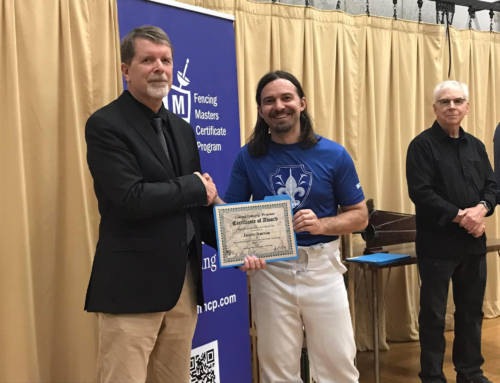
In 2024, I passed my Instructor at Arms exam in Italian foil. This past weekend, I passed the exam for Provost at Arms in Italian foil, saber, and epee.
Since I get a lot of questions about the program and the examination, I wanted to document my experience here for folks. And, of course, I’m always happy to answer questions directly via email or social DMs.
The goal of this program is to teach and continue the classical Italian fencing tradition. It is not the best or only way of coaching out there, but provides a really solid foundation for teaching others how to fence. Even though this is done with foil, saber, and epee, the theory and coaching tools I learn from FMCP carries over to other weapons I teach, such as rapier, smallsword/dueling sword, and military saber to SCA-HEMA folks.
I was extremely stressed leading up to the exam. Between my full-time day job, running Boston Academie d’Armes, household chores, and keeping up with important personal relationships, I didn’t have as much time to prep as I would have liked.
Amusingly, I felt like I was too busy coaching to study for my coach’s test.
So I went into this test not as prepared as I would have liked. But perhaps no one ever truly is.
I did feel like I hit max knowledge saturation for this round of testing a couple of weeks ago.


The FMCP is a pretty rigorous test. It includes…
 Written Exam. Which I had taken previously.
 Research Paper. Also done previously. I wrote about “yielding glides” and that paper can be found here.
 Group Lesson. This is done in a military style; not how I usually run classes, but it’s part of the program’s tradition.
 Oral Exam. The Board asks you theory-related questions.
 Give a Lesson. Give an individual lesson in the classical tradition.
 Take a Lesson. Be a student in an individual lesson. Graded on execution, etc.
 Random Actions. The Board gives you actions to teach your student on the spot.
Part of the online class but not part of the official examination was doing a history video, too. You can watch my contribution to that here.
This year, the Oral Exam, “Give a Lesson” and “Take a Lesson” were done for all three weapons, Random Actions for two weapons, and Group Lesson for one weapon.
We had a large cohort of people testing this year — 5 provosts and 1 instructor. Was really cool.

Group Lesson
The military-style Group Lesson was just one weapon this year. I had a 50-50 shot between saber and epee (one of the maestri had a spinning wheel app on their phone).
I prayed to the Fencing Gods to grant me saber.
They laughed, of course, and gave me epee.
I wrote down an epee lesson months ago but didn’t memorize it (see above: brain saturation), so I made one up on the fly. A benefit of the FMCP program is the lesson structure you learn. If you understand the structure and the weapon, you can make a lesson up on the fly without issue.
I, of course, almost forgot about angulations in the lesson. I got part way through and realized I forgot so tried to humorously acknowledge this fail with a “And now we’re going to go back in time.” So it made it in there, just out of order.
Would’ve been better if I did the Wayne’s World flashback finger waves.
Video below.
ACTIONS
- From the instructor’s invitation of 3rd, straight thrust to the body
- From the instructor’s invitation of 3rd, straight thrust to the crook of the arm
- From the instructor’s invitation of 2nd, straight thrust to the wrist
- From the coach’s engagement of 3rd, disengagement to the body
- From the coach’s engagement of 3rd, disengagement to the crook of the arm
- From the student’s engagement of 3rd, glide to the crook of the arm
- From the coach’s blade in line, angulation from beneath
- From the student’s engagement of 3rd, simple parry of 2nd (with a retreat) and riposte by detachment to the crook of the arm
- From the student’s engagement of 3rd, circular parry of 3rd (with a retreat), and riposte by glide to the crook of the arm
- From the student’s engagement of 2nd, feint by glide and disengagement to the crook of the arm
- From the student’s engagement of 4th, flanconade of 2nd
- From the student’s engagement of 3rd, arrest with reassemblement
- Three straight thrusts. End of lesson.
The military style of giving a group lesson isn’t my favorite way to teach — though it does look really cool when everyone synchs up. I was really worried about this portion of the test at instructor level but found it a lot less worrisome this time around.
It’s not how I’ll teach group lessons at the Academie but I appreciate what it’s meant to do. I can see it being an interesting way of showing off at a demo, too.


Oral Exam
The next day was the main event, starting with the oral exam. The board asks questions related to fencing theory, pedagogy, and history.
This is the worst part of testing for me. Not that I don’t think I know anything but if I get too stressed I worry my brain will start to shut down and I go blank. Sometimes the questions can be a bit awkward or clunky as the maestri try to probe for knowledge without leading too much. But they’re very good about clarifying things.
We got questions for all three weapons at provost level — Italian foil, saber and epee. Sometimes there were follow up Qs.
Here are the questions I got. It’s not a 1:1 on verbiage, but the gist of the inquiries.
Foil Questions
- What are the Italian invitation/engagement positions and the French equivalents?
- How would you teach probing actions to a student?
- What is the contrary to probing actions?
- Why would you use 3rd hand in 2nd instead of 3rd hand in 4th? Why would you use 2nd hand in 2nd instead of 2nd hand in 4th?
- What is “weapon in line?” What is it used for?
Epee Questions
- What’s the most common counterattack in epee? What targets do we direct it at?
- What’s a common issue we see when teaching the Angulation and how can we fix it?
- Tell us the history of the epee and is there a better weapon for the Italians in this realm?
The epee history Q was especially funny since the maestro asked “Can you name a 16th Century epee master?” and I was really confused and wondering what trap was being laid before me. In practice, it was just him being cutesy to lead to the “why do we have this weapon?” questions.
There was one other epee question, but I couldn’t remember what it was when I sat back down.
Saber Questions
- After the grazing beat of 4th, where is the final attack directed to?
- What are the transports in saber?
- In saber, you can transport from 3rd to 1st and from 1st to 3rd. That would be an envelopment in foil. Why don’t we have envelopments in saber then?
- What is tempo commune? Why is it so common in modern saber and not in modern foil?
The modern sports Q isn’t 100% accurate verbiage. We kinda got to that topic through a windy path talking about double hits and how modern saber/foil and classical saber/foil differ. So take what it with a grain of salt.

Individual Lessons
Next up was giving and taking individual lessons.
My partner this year was Marli of HARP Fencing. We’ve been friends for years and work well with one another, so it was an easy match for the exam.
This year, the Board allowed us to go a little more non-traditional with the lesson. A more traditional lesson in this case would be something closer to what I did for the Group Lesson but with some light mobility or in-time actions.
For my lessons, I wanted to write up more tactical lessons with choices, in-time actions, and more mobility. I wanted to show that I could “build a fencer” with the pedagogy we study. Essentially, I wanted to make my exam harder for myself. We can debate how wise this was but it was important to me to show how much I could do to help prove/earn that cert.
As a general note: For each action, I would start off with verbal control (a staple of the tradition), then move into in-time (blade action cues the student), and then in-time with mobility (student keeps distance with the instructor).
I don’t have video of the actual exam lessons but I do have some video from when I was practicing it with Steve (another provost candidate) and Eli (one of my students at the Academie). The video isn’t a perfect 1:1 of the final lesson script, but it will give folks a general idea of things.
Foil
Theme: Tactical decision making. Actions in 4th.
- From the coach’s invitation of 3rd, straight thrust
- From the coach’s engagement of 3rd, disengagement
- From the student’s engagement of 4th, glide
- OPTION DRILL: As the coach attempts to engage in 3rd, disengagement Or as the coach places blade in line, glide
- From the student’s engagement of 4th, flanconade in 4th
- OPTION DRILL: From the student’s engagement of 4th, glide Or Flanconade of in 4th
- From the student’s invitation of 3rd, simple parry of 4th & riposte by glide
- From the student’s invitation of 3rd, simple parry of 4th & riposte by flanconade in 4th
- OPTION DRILL: From the student’s invitation of 3rd, simple parry of 4th & riposte by glide Or flanconade of 4th
- From the student’s engagement of 4th, feint by flanconade of 4th & disengagement
- From the student’s engagement of 4th, circular parry of 4th & riposte by glide
- From the student’s blade seizure in 4th, glide
- From the student’s blade seizure of 4th, Flanconade of 4th
- OPTION DRILL: From the student’s blade seizure of 4th, glide Or Flanconade of 4th
- From the student’s attempted blade seizure of 4th, passata sotto.
- OPTION DRILL: From the student’s blade seizure of 4th, glide Or flanconade of 4th Or passata sotto
- Three straight thrusts. End of lesson.
Saber
Theme: Transitioning from Offense to Defense. Not every attack will land and it’s important for fencers to get used to transitioning from offense to defense after failed attacks. Goal of this lesson is to let students build that vital skill; be explosive in attack but be able to transition to defense instantly.
General coaching note: At random, the coach can parry the student’s offense and riposte. The student should counter-parry and riposte. The coach can adjust the speed and intensity of their riposte to allow the student to have enough time to read and transition. Counter-parries should be from the lunge.
- From the coach’s invitation of 3rd, direct point thrust to the chest
- From the coach’s engagement of 3rd, disengagement with the point
- From the student’s engagement of 3rd, glide with the point
- From the coach’s invitation of 2nd, direct cut head
- From the coach’s invitation of 5th, direct cut flank
- OPTION: From the coach’s invitation of 2nd or 5th, direct cut head Or flank
- From the coach’s engagement of 3rd, descending cut to the head
- From the student’s invitation of 2nd, parry 5th & cut flank
- From the coach’s invitation of 2nd, feint cut head, cut flank
- OPTION: From the coach’s invitation of 2nd or 5th, feint cut head & cut flank Or feint cut flank & cut head.
- From the student’s invitation of 3rd, simple beat of 4th (w/back edge) & cut right cheek
- OPTION: From the student’s invitation of 3rd, simple beat of 4th (w/back edge) & cut right cheek OR parry 5th and riposte direct cut to the flank OR (against coach’s invitation of 2nd) direct cut to head
- From the student’s invitation of 3rd, stop cut to arm (on retreat), parry 5th & riposte cut to the flank
- OPTION: From the student’s invitation of 2nd, direct cut head OR stop cut to the arm, parry 5th & riposte cut to the flank
- Three direct point thrusts (coach’s invitation of 3rd). End of lesson.
Epee
Theme: Targeting based on distance; harassing the hand to get to the body
- From the coach’s invitation of 3rd, straight thrust to the body
- From the coach’s invitation of 2nd, straight thrust to the wrist
- From the coach’s engagement of 4th, disengagement to the external arm
- From the student’s engagement of 3rd, glide to the arm
- From the coach’s blade in line (high), angulation from beneath
- OPTION DRILL: From the coach’s invitation of 2nd, straight thrust to the wrist Or blade in line (high), angulation from beneath
- From the student’s invitation of 3rd, circular parry of 3rd (with a retreat) & riposte by glide to the arm
- OPTION DRILL: From the coach’s invitation of 2nd, straight thrust Or blade in line (high), angulation from beneath. If coach attacks after initial touch, circular 3rd & riposte by glide to the arm.
- From the coach’s invitation of 2nd, straight thrust to the wrist (on advance) & disengagement to the body
- OPTION DRILL: From the coach’s invitation of 2nd, straight thrust to the wrist (on advance) & disengagement to the body Or blade in line (high), angulation from beneath. If coach attacks after initial touch sequence, circular 3rd & riposte by glide to the arm
- From the coach’s invitation of 3rd, feint direct to the internal arm and disengagement to the external arm.
- OPTION DRILL: From the coach’s invitation of 2nd, straight thrust to the wrist (on advance) & disengagement to the torso Or blade in line (high), angulation from beneath Or invitation of 3rd, feint direct to internal arm & disengagement to external arm. If coach attacks after initial touch, circular 3rd & riposte by glide to the torso
- From the student’s invitation of 3rd, arrest with reassemblement
- OPTION DRILL: From the coach’s invitation of 2nd, straight thrust to the wrist (on advance) & disengagement to the torso Or blade in line (high) angulation from beneath Or attack to the leg, arrest with reassemblement.
- Three straight thrusts (coach’s invitation in 3rd). End of lesson.
Random Actions
Last up is Actions at Random. Essentially, the Board gives the candidates an action to work on.
Sometimes these are pretty direct actions with varying lengths and complexities of sequences. Sometimes the actions are puzzles that the candidate needs to work through and figure out.
I used to find these very stressful but now find them more enjoyable. It’s playtime. If you know the syntax and theory, you’ll at least get really close to the correct answer. Often times there are multiple solutions to the puzzles.
Because of time, I got just two random actions — one for foil and one for saber.
Foil
This one was more of a puzzle to figure out and, not gonna lie, had me cooking for a bit until I was able to unravel exactly what was being asked (how it was worded had me lost at first).
- Summary: Show a compound attack and teach your student a counterattack that could be done during each tempo of that attack.
For this, I did a double feint by disengagement and disengagement (from the student’s invitation of 4th). The counter attacks I had Marli do:
- Arrest in the first tempo to the high-outside line
- Arrest in the second tempo to the low-outside line
- Time-thrust in the third tempo to the low-outside line
I didn’t get too cutsie with this one. In hindsight, I couldn’t done a simple beat & feint direct and disengagement which would’ve let for the counterattacks being a disengagement-in-time (first tempo), arrest (second tempo), and a time-thrust or inquartata for third tempo. What I did was fine, but this would’ve allowed for more variety.
Saber
Random Action for saber was a bit more direct.
- From the student’s engagement of 2nd, transport to 4th with an advance, expulsion and direct cut to the cheek.
After that, they added a second action:
- …parry and riposte to the cheek
I settled with a simple parry of 4th and cut cheek to keep things simple for Marli. We also did this with mobility at combat speeds — to the delight of the Board.


Final Thoughts
Overall, I can’t complain too much as I passed my exam and got my Provost at Arms cert.
I didn’t perform as well as I would have liked but did score better than I thought, considering how the day was going and the notes I got. It’s hard to gauge where things are when you’re in the pressure cooker.
But all that work paid off.
I’m now looking forward to taking a break from studying to read other fencing books and work on other projects.
Then we start the process of reaching Maestro level.