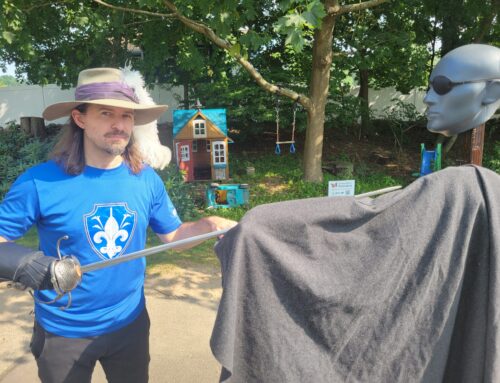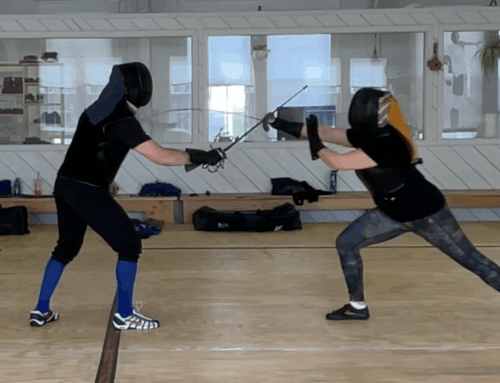


A couple of years ago, I did a fun experiment to test the armor protection a wool cloak would give a fencer in a duel against a sharp sword. We looked at thrusts, cuts and slices. You can read the results of that experiment in my paper.
About a month ago, Donovan and I were inspired to bring this idea of sharp sword work to the East Kingdom. We thought it would be a fun way to give local fencers a new perspective of what calibration and attacking with a sharp sword is like.
 INSPIRATION
We talk a lot about calibration in fencing and what would or wouldn’t injure an opponent — but for 99.99% of folks, we’re making some sweeping assumptions.
First let’s look at SCA rules on calibration and armor standards.
SCA Rapier Handbook: Conventions – Acknowledgement of blows (11.1):
In judging blows, you are presumed to be wearing thin clothing, such as unpadded linen, and your opponent’s weapon is extremely sharp on point and edge. Any blow that would have penetrated the skin, in your judgment, is valid. Kingdoms are not allowed to alter this standard.
Then in the next section (11.2 Calibration):
You must deliver all blows in combat with control, with the aim of delivering the lightest blow that your opponent judges to have penetrated the skin (a “valid blow”).
It’s pretty clear that blows should be landed as light as possible that would injure the opponent in a duel. However, we do see various interpretations of that idea throughout the SCA.
Some kingdoms opt for a “lightest touch” calibration while others aim for more “positive pressure.” Both are done assuming that level of calibration (“how hard we hit each other”) is what’s needed to penetrate an opponent with a sharp in a duel.
We obviously don’t want folks to actually go out and stab one another, so we attempted the next best thing — covering a ballistic gel torso in a wool doublet.
So how hard does one need to attack for it to injure an opponent?
Josh Handel did a great research paper entitled On the Force Required to Penetrate Men’s 16th Century Upper Body Clothing.
In it, he tests and discusses the force level needed to penetrate through various fabric types and fabric combinations. It’s a fascinating paper and I highly recommend folks give it a read.
For example:
Linen shirts offered no measurable protection, while all doublets provided some level of defense.
The linen doublet simulation required 61.73 N to penetrate, demonstrating significant resilience.
Silk doublet simulations showed inferior protection compared to linen doublets, highlighting material density’s role.
Of course, while hard data like that is great for real science, humans don’t operate the same way. We’re not fencing thinking, “I need just under 62 N to win this fight.”
We go by feel. We work off of perception.
That’s what this experiment/demo was about.
Our goal was two-fold:
- Test people’s assumption about calibration and injury.
- Give folks a fun, interactive experience about how attacking an opponent with a sharp sword feels.
We weren’t aiming for hard data collection. It was to let folks test their own assumptions about calibration and what could potentially injure an opponent.
It also let folks get a sense for how a sharp sword feels upon impact.
It was both fun and educational.
 SET UP


The torso was the Ballistic Gel Torso Headless no Internals from Ballistic Dummy Lab. He’s wearing an old linen fencing shirt of mine that needed to be retired, plus a wool soldier’s coat (sans-sleeves) lined with linen. Unpadded and no interlining. Nothing fancy, but a reasonable simulator of what someone might wear in a rapier sword-fight and within parameters of SCA rules.
The torso was primarily thrust-only.
The torso holder was designed by me. My partner Kate worked her magic and took my sketch and turned it into reality. We made it so it would work with my pre-existing pel (which unfortunately no longer is available for purchase). We weighed it down with sandbags but the torso (at 75lbs) made it all so top heavy that we had to ratch it to itself (thanks, Frosty!) to keep it from falling or the rig breaking.
As Kate joked, “It’s the best engineering a college history degree can buy.” It worked great.
We also did some test work with a ballistic gel head, as a fun added bonus experience for folks. The head is also from Ballistic Dummy Lab. We let folks throw thrusts, cuts and slices to it. It was held in place with a primitive rig that we need to improve upon next time.
The rapier is the ColdSteel “Cavalier Rapier.” Same thing I used for the Rapier vs Cloak experiment a couple of years back.
We did let folks bring and use their own personal weapons. Included was a sharp longsword, messer, arming sword, and various knives and daggers.
Safety Measures
Sharp swords aren’t toys. So we build in some safety measures to make sure everyone involved didn’t get injured (spoiler: we did four hours of this straight with zero injuries).
Safety measures included:
- Marking off a wide area for the experiment with orange and yellow safety cones and list ropes
- Participants were required to wear a glove on their sword hand
- Participants were required to wear eye protection
- Participants were required to wear toe-enclosed footwear
 PROCESS
For the torso, we had folks do three thrusts. Each with increasing level of force.
- “Lightest Touch”
- “Positive Pressure”
- “Eh, have fun with it”
This was all based on what those phrases meant to the individual person. Again we were testing assumptions and not actual force.
This was light & interactive experiment and not for hard-data collecting.
 RESULTS

We had between approximately 50-55 participants over the four hours of play.
Almost everyone’s lightest touch was able to pierce all three layers and into the gel torso. There were a few people who’s lightest touch just tickled the cloth, but even some of the most light-handed fencers in the East were able to penetrate to the body with little effort.
It was incredibly lopsided.
I honestly was expecting more “lightest touch” shots to not do much. Goes to show just how vulnerable one is against a sharp and how little effort is needed to reach the body.
NOTE: While “lightest touch” shots reached the body, they didn’t enter very deep, which is to be expected since folks are stopping at the body and not through the body where a sparring blade would bend significantly.
Here’s a select few participants.
Some folks brought their own weapons for testing.
The longsword, expectedly, delivered devastating injuries to the head. One arming sword was also brutal on the thrust and cut — and the individual who made it was worried about it not being sharp enough.
We had a sharp messer that struggled to pierce through the doublet, but it did push the wool and linen into the torso. Unsure if the weapon just wasn’t sharp enough, the point geometry was weird/off/bad or if things would work differently if there was a sternum beneath the gel.
Daggers and knives were also pretty brutal. A knife that Kate brought was the only item that was slicing through the doublet layers. Everything else skated off of it.
Some folks tried hard to run the torso through and everyone kinda hit a wall. My guess is that the gel just has more resistance the deeper you go that was stopping the blade from going all the way through. This is just a guess.


 FINAL THOUGHTS

Photo by Lauren Dubois
We had people in line non-stop from 10am-2pm. Four hours. No injuries. Thanks, everyone, for that.
It was a lot of fun to bring sharp-sword work to the larger East Kingdom populace. We obviously had pretty much every fencer on site show up and give it a whirl.
We had a lot of folks who never held a sword before give this a try, so this was their entry into swordfighting. That was also really cool.
Folks who chipped off some bone were sent home with their prize — a “relic.”
As for the lightest touch shots going through so easy — it could be that it is just that easy OR it could be because people calibrate based on feedback they get when they hit their target with a tipped sword. They didn’t have that here, so they didn’t pull back/collapse their arm/whatever like usual.

Photo by Lauren Dubois
Without sensors or a way to measure force, we were left trusting folks were attack the same as they do. Again, this was mostly to let folks test assumptions and have the experience of a sword penetrating a target.
Maybe don’t claim “that was too light” unless the shot was literally just tickling the fabric of your outfit. Even then, the phrase is a bit inaccurate.
 We did ask for donations from participants since this was an expensive demo, but it wasn’t required and we didn’t “check folks at the door.” Donations that we received covered about 68% of the total cost.
If anyone else would like to donate to help cover the final bit, you can do so here. Much appreciated.
 My rapier also took a beating. The blade now has a pretty set C-curve and a grip and pommel is loose. The latter can be fixed but unlikely the former, so I’ll need to get a new sharp. A bummer, but I knew the risk of letting a lot of folks use it for that long and for that level of energy. Some folks got a little spicy in their final shots.
Overall, it was a lot of fun. We all learned a lot and have ideas about what we’d do differently in the future if we get a chance to do it again.
Thanks to everyone who came out to try and to the Barony of Carolingia for letting us run this.
Here are a couple of fun videos to end things with.
DONATIONS: If you found this post useful or interesting, please consider a small donation so I can continue to produce rapier & other historical martial arts content. Donate at https://www.paypal.com/paypalme/BostonAcademiedArmes